Riverland Dubai
Riverland Dubai is one of those places that makes you question how many people actually understand Dubai versus how many people just skim it. On paper, it sits inside Dubai Parks and Resorts, which immediately causes most residents to mentally file it under “tourist zone” and move on. In reality, Riverland is something else entirely. It’s not a park, not a mall, not a theme attraction, and not quite a public space either. It’s a transitional environment, and that’s exactly why it works.
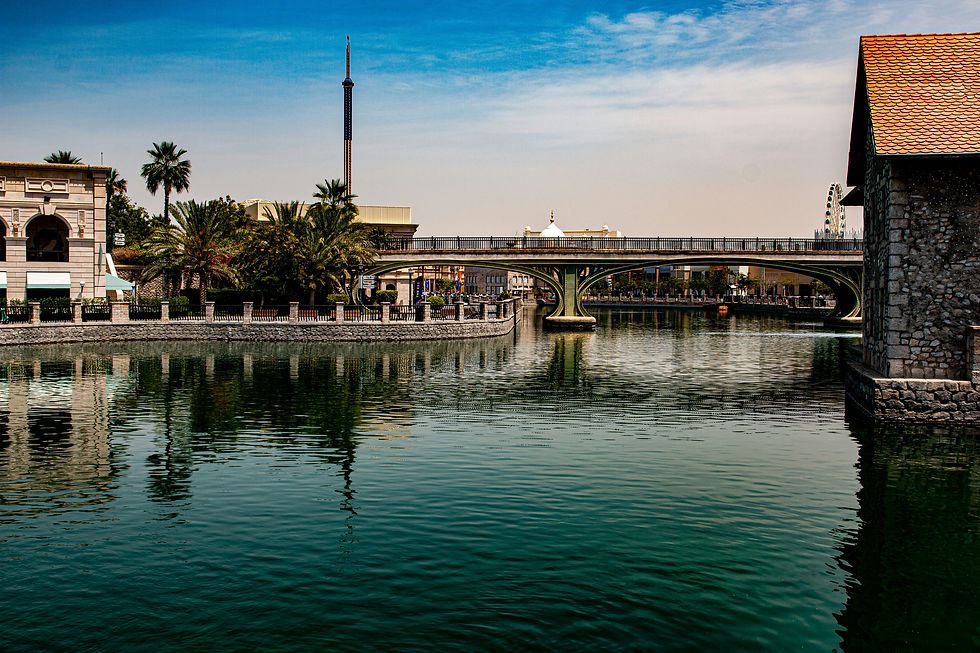
Riverland is designed as a connective spine between major theme parks, but it accidentally becomes its own destination. The entire area is built around a river that winds through different architectural eras, each representing a stylized version of place and time. It sounds gimmicky until you’re actually there. Once you’re walking it, the design fades into the background and the experience becomes about pace, scale, and atmosphere.
What immediately separates Riverland from most leisure spaces in Dubai is how calm it feels. Despite the size, it never feels frantic. Paths are wide, sightlines are long, and movement flows naturally. You’re not herded. You’re not rushed. You’re not forced into consumption at every turn. You’re allowed to exist there without immediately spending money, which in Dubai is almost radical. The river itself does a lot of the heavy lifting. Water slows people down psychologically. It creates pauses. It invites sitting, leaning, watching, and waiting. Riverland uses this to its advantage. Benches, bridges, and open edges permit you to stop moving without feeling like you’re in the way. That alone changes how long people stay.
Timing is crucial to experiencing Riverland properly. Weekday afternoons are ideal if you want the place almost to yourself. Evenings, especially outside peak tourist seasons, strike the best balance. The lighting comes on gradually, reflections appear on the water, and the whole area shifts into a softer, more cinematic mode. It’s one of the few places in Dubai where night doesn’t mean noise. Architecturally, Riverland avoids hyper realism. Each zone is impressionistic rather than accurate. It gives you enough cues to suggest a place or era, but not so many that it becomes theatrical. This restraint matters. It keeps the experience from tipping into theme park territory and allows adults to enjoy it without irony.
Riverland is especially strong for low pressure social time. It’s ideal for long walks with conversation, casual meetups, or decompressing after something intense. You can bring someone here without committing to a full plan. If it clicks, you stay. If it doesn’t, you leave without friction. There’s no obligation built into the space. Food and cafés here play a supporting role rather than dominating the experience. You eat when you want, not because you’re forced into a food court moment. That flexibility makes the entire area feel more grown up than most entertainment districts in the city.
Another underrated aspect is how photogenic Riverland is without being obvious. It doesn’t scream for cameras, but it rewards them quietly. Reflections, symmetry, bridges, and long corridors create visuals that feel cinematic rather than social media optimized. It’s the difference between documenting a place and performing inside it. For residents, Riverland works best when you strip it of expectations. Don’t come looking for thrills. Don’t come expecting spectacle. Come expecting space. It’s a place to stretch time, not compress it. In a city that often moves too fast, that’s a valuable function.
Riverland also hints at a side of Dubai that’s rarely acknowledged. The city can build environments that prioritize mood over metrics. Not everything needs to be measured in footfall or spend per head. Some spaces exist to balance the system, and Riverland quietly does that. If Dubai’s malls represent consumption and its beaches represent escape, Riverland represents transition. Between places. Between plans. Between states of mind. That makes it a powerful, if understated, addition to the Playbook. It’s not iconic. It’s not famous. And that’s exactly why it deserves attention.


Comments